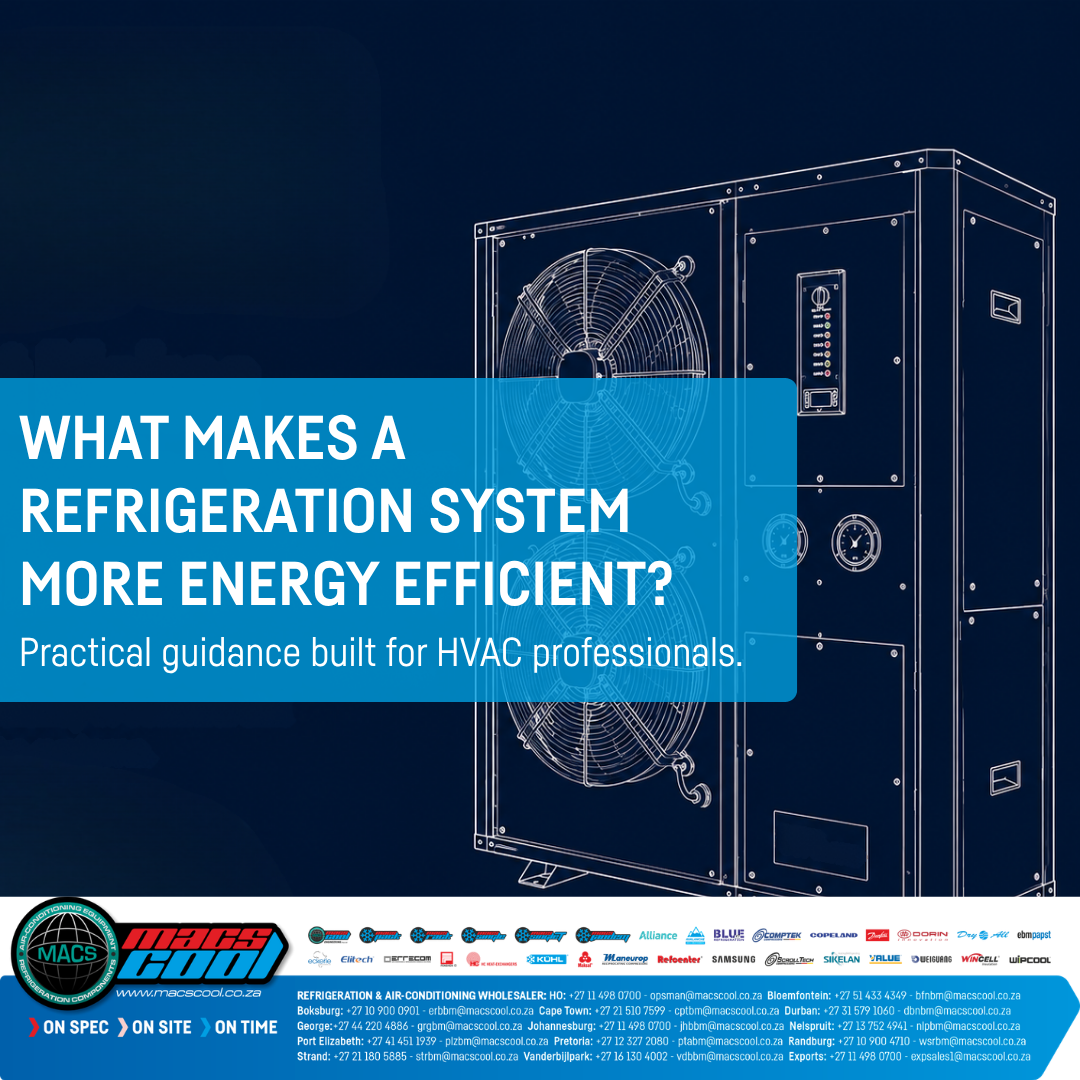
Energy efficiency in commercial refrigeration is not determined by one compressor, control, refrigerant or maintenance task. It depends on how the complete system is designed, selected, installed, controlled, maintained and operated.
An energy-efficient commercial refrigeration system is one in which the components are correctly selected, properly installed and controlled according to the actual cooling demand.
For contractors, technicians, consulting engineers, system designers and operators, this whole-system principle is essential. A component may perform well on its own, but total system efficiency can still be affected by inaccurate load calculations, poor airflow, unsuitable control settings, damaged door seals or inadequate maintenance.
Efficiency can be supported through regular servicing, good operating practices and early identification of system problems.
Start With an Accurate Load Calculation
Correct system design begins with understanding the actual cooling demand.
The refrigeration load may be influenced by factors such as:
- The size and use of the refrigerated space
- The type, quantity and temperature of products entering the space
- Door-opening frequency
- Heat entering through walls, ceilings, floors and doors
- Internal lighting, equipment and people
- Air infiltration
- Required storage or process temperatures
- Operating schedules
- Local installation conditions
An inaccurate load calculation can affect equipment selection and system operation.
If the calculated load is too low, the system may struggle to maintain the required conditions during periods of higher demand. If it is too high, oversized equipment may cycle unnecessarily or operate outside its intended range.
The objective is not simply to choose larger equipment. It is to understand the application and select correctly sized equipment for the expected operating conditions.
Match Every Major Component to the Application
Commercial refrigeration equipment should be selected as a coordinated system.
Compressors, evaporators, condensers, controls, fans, expansion devices, pipework and other components must work together under the expected load and operating conditions.
Compressor Selection
Compressor selection and capacity control contribute to efficiency as part of the complete system.
The selected compressor should suit the refrigerant, operating temperatures, expected load range and system design. Selecting a compressor without considering the rest of the installation may contribute to inefficient operation or inconsistent temperature control.
Evaporators
The evaporator must provide the required cooling capacity while allowing suitable airflow across the coil and throughout the refrigerated space.
Poor evaporator selection or placement may contribute to:
- Uneven temperatures
- Longer operating periods
- Inadequate product cooling
- Ice formation
- Restricted airflow
The evaporator, fan arrangement and defrost strategy should be considered together.
Condensers
A condenser must reject heat effectively under the expected installation conditions.
Restricted airflow, dirt, poor placement or recirculation of hot discharge air may raise condensing conditions and increase the work required from the system.
Suitable positioning, clear airflow paths and regular cleaning support effective heat rejection.
Use Capacity Control to Follow Actual Cooling Demand
Commercial refrigeration loads are rarely constant throughout the day.
Door openings, product loading, ambient conditions, production activity and trading hours may all change the cooling demand. A system that can respond appropriately to these changes may avoid unnecessary operation at full capacity.
Capacity control can involve suitable compressor staging, variable-speed operation or other approved control strategies.
The correct approach depends on the application, equipment and system design. Capacity control should not be treated as an isolated upgrade. It must be matched to the complete system and commissioned correctly.
Protect Airflow Throughout the System
Airflow is central to heat exchange.
At the evaporator, air must move across the coil and circulate through the refrigerated space. At the condenser, air must remove heat from the refrigerant and discharge it without obstruction.
Efficiency and system performance may be affected by:
- Blocked or dirty coils
- Incorrect fan operation
- Obstructed air paths
- Poor evaporator placement
- Product stacked too closely to the evaporator
- Damaged fan blades
- Incorrect fan-speed settings
- Hot condenser discharge air recirculating into the intake
Good airflow begins with correct system design and installation. It must then be protected through suitable operating practices and preventative maintenance.
Reduce Unwanted Heat Through Insulation and Sealing
A refrigeration system must remove heat that enters the refrigerated space. Poor insulation or sealing increases this heat load.
Important areas include:
- Cold-room wall, ceiling and floor insulation
- Door seals and gaskets
- Door alignment
- Service penetrations
- Pipe insulation
- Openings around cables and pipework
- Damaged panels or joints
Damaged seals or poorly closing doors may allow warm, moist air to enter the space. This can increase the cooling demand and contribute to frost or ice formation.
Operators should also avoid leaving doors open longer than necessary. Where appropriate, operating procedures can help reduce unnecessary air infiltration.
Maintain the Correct Refrigerant Charge
Correct refrigerant charge is one of several factors that supports effective system operation.
Both insufficient and unsuitable charging conditions may affect heat transfer, operating pressures and temperature control. Refrigerant charge should therefore be assessed as part of the complete system, rather than as a stand-alone explanation for poor performance.
Refrigerant-related work must be completed by appropriately competent persons and must follow applicable safety, environmental and compliance requirements.
Where performance changes unexpectedly, technicians should investigate the system carefully rather than assuming that adding refrigerant will resolve the problem.
Apply Controls That Suit the System and Application
Appropriate controls can help the system respond more closely to actual cooling demand.
Depending on the application, this may include:
- Temperature controls
- Pressure controls
- Electronic expansion valves
- Fan-speed controls
- Compressor staging
- Defrost controls
- Alarm functions
- Monitoring systems
Control settings must be appropriate for the equipment, product requirements and operating conditions.
Incorrect setpoints, poorly placed sensors or unsuitable control sequences may cause excessive cycling, unstable temperatures or unnecessary operation.
Controls should be commissioned, tested and reviewed as part of the complete installation.
Optimise the Defrost Strategy
Defrost is necessary in applications where frost builds up on the evaporator. However, unsuitable defrost timing or settings may introduce unnecessary heat into the refrigerated space or allow frost to restrict airflow.
A suitable defrost strategy should consider:
- The type of system
- The operating temperature
- Humidity and air infiltration
- Door-opening frequency
- Product loading
- The rate of frost formation
- The selected defrost method
- Drainage and termination settings
Defrost should occur when required, for an appropriate duration and with suitable termination controls where applicable.
The system should also return to normal operation correctly after defrost.
Support Efficiency Through Correct Installation
Even correctly selected equipment may perform poorly if installation quality is inadequate.
Installation factors that may affect performance include:
- Incorrect pipe sizing or routing
- Poor pipe insulation
- Contamination inside the system
- Incorrect sensor placement
- Inadequate drainage
- Poor equipment positioning
- Restricted service access
- Incorrect electrical or control connections
- Insufficient airflow clearances
Commissioning should confirm that the installed system operates according to the design intent.
Readings and settings should be documented where required so that future servicing teams have a useful performance reference.
Use Preventative Maintenance to Protect Performance
Preventative maintenance can help identify developing problems and support more consistent system performance.
A practical maintenance programme may include checking:
- Evaporator and condenser cleanliness
- Fan condition and operation
- Airflow
- Door seals and door alignment
- Insulation condition
- Refrigerant charge indicators
- Operating pressures and temperatures
- Control settings and sensor accuracy
- Defrost operation
- Drainage
- Electrical connections
- Unusual noise or vibration
Maintenance frequency should suit the system, application and operating environment.
Busy kitchens, food-processing facilities, supermarkets, cold stores and outdoor condenser installations may face different operating conditions. The maintenance plan should reflect those conditions.
Improve Day-to-Day Operating Practices
Efficiency is not only a design and maintenance responsibility. Daily operating practices also influence the cooling demand.
Useful practices may include:
- Keeping cold-room and display doors closed when not in use
- Avoiding blocked evaporator airflow
- Following appropriate product-loading procedures
- Reporting damaged seals promptly
- Keeping condenser areas clear
- Avoiding unapproved changes to setpoints
- Recording recurring alarms or temperature deviations
- Allowing maintenance access to equipment
Clear responsibilities help prevent small issues from becoming persistent system problems.
Monitor Performance and Investigate Changes Early
Performance monitoring helps operators and service teams recognise when a system is no longer operating as expected.
Useful indicators may include:
- Temperature trends
- Compressor running patterns
- Alarm history
- Defrost frequency
- Pressure and temperature readings
- Fan operation
- Ice or frost formation
- Door condition
- Changes in product loading or operating hours
A change in energy use or operating behaviour does not automatically identify the cause. It signals that the system should be assessed.
For example, longer operating periods may relate to a dirty condenser, damaged seals, altered product loads, poor airflow, incorrect settings or another system condition.
Monitoring is most useful when readings are reviewed in context and compared with suitable reference information.
A Whole-System Approach Supports Better Decisions
Commercial refrigeration energy efficiency requires more than selecting an efficient component.
It depends on:
- Correct system design
- Accurate load calculation
- Correctly sized equipment
- Suitable compressor selection
- Effective capacity control
- Appropriate evaporator and condenser selection
- Good airflow
- Effective insulation and sealing
- Correct refrigerant charge
- Suitable controls
- An appropriate defrost strategy
- Quality installation and commissioning
- Preventative maintenance
- Good operating practices
- Ongoing performance monitoring
For South African contractors, engineers, technicians and refrigeration operators, this approach helps keep the focus on the actual application rather than isolated product claims.
MACS Cool supplies refrigeration equipment, components, tools and supporting products for a range of trade applications. As a dependable trade partner, MACS Cool provides practical support from first quote to final install.
On Spec. On Site. On Time.
Frequently Asked Questions
What Makes a Commercial Refrigeration System Energy Efficient?
An energy-efficient commercial refrigeration system is one in which the components are correctly selected, properly installed and controlled according to the actual cooling demand. Efficiency also depends on regular servicing, good operating practices and early identification of system problems.
How Can a South African Business Improve Commercial Refrigeration Energy Efficiency?
A business can begin by arranging an assessment of the complete system. This may include the load calculation, equipment sizing, airflow, condenser and evaporator condition, insulation, door seals, refrigerant charge, control settings, defrost operation and maintenance practices. Any refrigerant-related work should be completed by appropriately competent persons.
Can One Component Make a Refrigeration System Energy Efficient?
No single component determines total system efficiency. Compressor selection, controls, evaporators, condensers, airflow, insulation, refrigerant charge, installation quality, maintenance and operating practices all contribute to how the complete commercial refrigeration system performs.